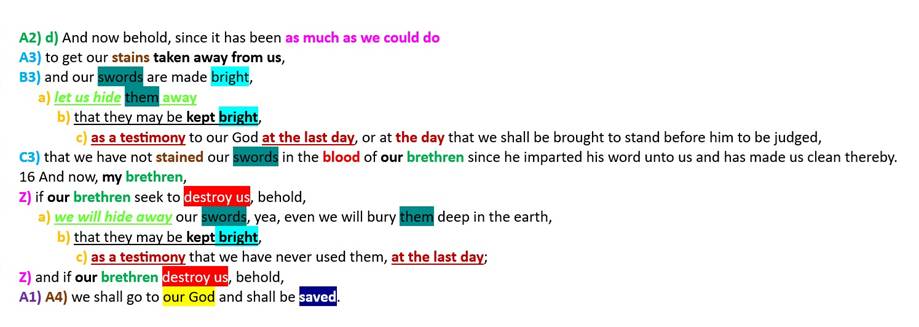
I use indents and letters to show the chiasmus and other forms
and also colors to help highlight the word matches.
In ancient Hebrew,
there were no exclamation points or bold text to show emphasis. Instead,
writers used repetition to convey deep emotion, emphasis, or a superlative
degree.
Chiasmus (Inverted
Parallelism): A mirror-like structure where a sequence of ideas marches forward
to a central climax, and then reverses out in exact backward order
(A-B-C-C'-B'-A'). The main theological point is always placed at the exact
center pivot.
Alternate: A four-line
pattern where the first line matches the third, and the second line matches the
fourth (a-b, a-b)
Extended Alternate: A six or
more-line pattern where the first set of lines matches the second or more set
of lines (a-b-c-d, a-b-c-d)
Synonymous: Line A = Line A' - Reinforces an identity
Antithetical: Line A is an opposite of A - Creates moral or
logical contrast
Climactic: (Staircase)
Parallelism: A key phrase from the first line is repeated at the start of the
second line, stepping up the intensity to deliver a brand-new, dramatic climax
at the end of the thought.
Anaphora: The strict
repetition of the exact same word or phrase at the beginning of
successive sentences or parallel lines to accumulate emotional momentum.
Epistrophe: The repetition of
the exact same word or phrase at the end of successive statements,
creating a rhythmic, echoing refrain (such as the repetition of "this
thing" and “unto thee” in Alma 41:1-2).
Symploce: A masterful
combination of both anaphora and epistrophe, where successive lines begin with
the exact same words and end with the exact same words, varying only the
middle content.
Epizeuxis (Reduplication):
The immediate, back-to-back repetition of a single word or name with no words
in between (e.g., "Abraham, Abraham" or "Holy, holy,
holy") used to denote urgency or the highest possible superlative.
Anadiplosis: A chain-linking
form where the final word of one poetic line is used as the very first word of
the next poetic line, tying the progression of thoughts together like links in
a chain.
Synthetic: (also known as
progressive parallelism) A poetic form where the second line of a verse does
not repeat or contrast the first line. Instead, it physically builds upon the
first line, adding new information, explanations, or context to complete and
advance the thought.
This is a formal speech by the king of
the Lamanites, I believe the formality is the reason for the highly poetically
structured format of the discourse. They
are also making a covenant with God having some ancient steps.
As background the king states that
they were introduced to God by their brethren the Nephites.
It was all they could do to repent of
their sins.
That their sins had been washed bright
in the blood of the Son of God.
God was merciful to them because he
loves them.
They will bury their swords as an
outward sign of their covenant proving a deep appreciation for God and to show
him of their commitment to Him.
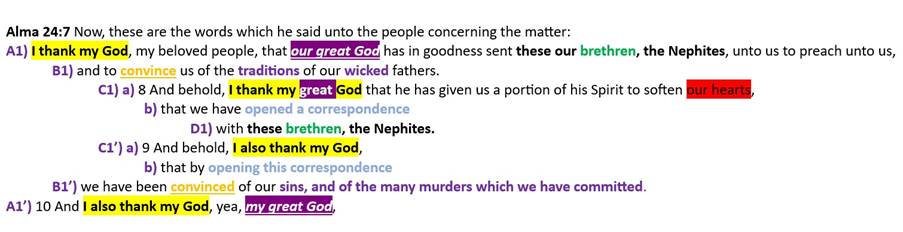
Alma 24:7 Now, these are the words which he said unto the people concerning the matter:
A1) I thank my God, my beloved people, that our great God has in goodness sent these our brethren, the Nephites, unto us to preach unto us,
B1) and to convince us of the traditions of our wicked fathers.
C1) a) 8 And behold, I thank my great God that he has given us a portion of his Spirit to soften our hearts,
b)
that we have opened a correspondence
D1) with these brethren, the Nephites.
C1’) a) 9 And behold, I also thank my God,
b)
that by opening this correspondence
B1’) we
have been convinced of our sins, and
of the many murders which we have committed.
A1’) 10 And I also thank my God, yea, my great God,
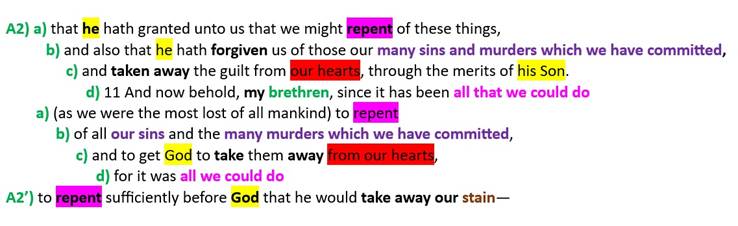
A2) a) that he hath granted unto us that we might repent of these things,
b) and also that he hath forgiven us of those our many
sins and murders which we have committed,
c) and taken away the guilt from our hearts, through the merits of his Son.
d) 11 And now behold, my brethren,
since it has been all that we could do
a) (as we were the most lost of all mankind) to repent
b) of all our sins and the many murders which we have committed,
c) and to get God to take them away from our hearts,
d) for it was all we could do
A2’) to repent sufficiently before God that he would take away our stain—
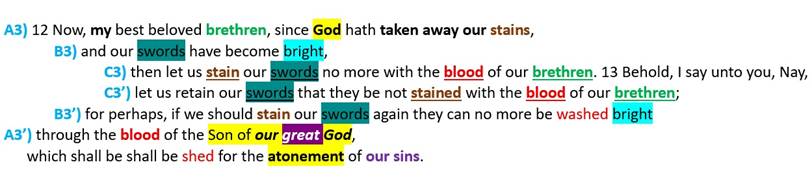
A3) 12 Now, my best beloved brethren, since God hath taken away our stains,
B3) and our swords have become bright,
C3) then let us stain our swords no more with the blood of our brethren. 13 Behold, I say unto you, Nay,
C3’) let us retain our swords that they be not stained with the blood of our brethren;
B3’) for perhaps, if we should stain our swords again they can no more be washed bright
A3’) through the blood of the Son of our great God,
which shall be shall be shed for the atonement of our sins.
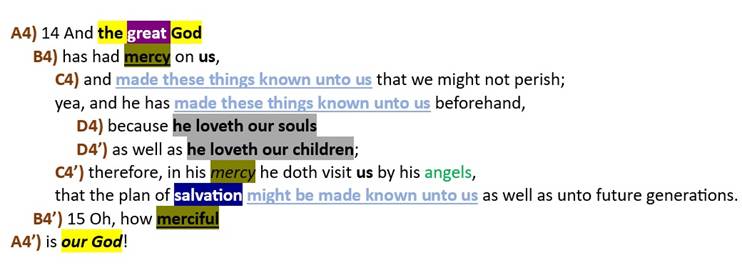
A4) 14 And the great God
B4) has had mercy on us,
C4) and made these things known unto us that we might not perish;
yea, and he has made these things known unto us beforehand,
D4) because he loveth our souls
D4’) as well as he loveth our children;
C4’) therefore, in his mercy he doth visit us by his angels,
that the plan of salvation might be made known unto us as well as unto future generations.
B4’) 15 Oh, how merciful
A4’) is our God!
A2) d) And
now behold, since it has been as much as we
could do
A3) to get our stains taken away from us,
B3) and our swords are made bright,
a) let us hide them away
b) that they may be kept bright,
c) as a testimony to our God at the last day, or at the day that we shall be brought to stand before him to be judged,
C3) that we have not stained our swords in the blood of our brethren since he imparted his word unto us and has made us clean thereby.
16 And now, my brethren,
Z) if our brethren seek to destroy us, behold,
a) we will hide away our swords, yea, even we will bury them deep in the earth,
b) that they may be kept bright,
c) as a testimony that we have never used them, at the last day;
Z) and if our brethren destroy us, behold,
A1) A4) we shall go to our God and shall be saved.
Below I’m including images of the text above so Google
can find and show the chiasmus images.